Now trending – the trends

Can you keep up with the trends that affect life? Should you?
The problem of signals to noises
In Silicon Valley we tend to be an echo chamber – you hear NFC, virtual wallets, co creation and a pile of other terms floating around, but it’s hard to get the fact check behind the trend to see if it is actually picking up steam, if it’s an actual reality and if it has ‘legs’. This is especially true because we tend to be siloed in our respective domains; I read more about UX design than I do about other fields, sadly. On top of that, we have more and more silos of content and discussion – so keeping up with what’s important is becoming more difficult in an attention economy. Blogs, Facebook, Twitter, email, forums – you get the idea.
The analysis of the problem
While there are piles of authoritative research sources (from Gartner to ComScore et al) that come out with their ‘State of Mobile 2011’ type reports, it would be handy to have a ‘what’s on the radar’ type feature – similar to Wired’s ‘What’s Hot or Not’, by each sector or by business trend. For me, if I see something mentioned on Facebook, Twitter, TechCrunch/online journalism etc. AND by a friend or authority in their field, I tend to believe it as a valuable trend worth paying attention too. It would be handy to have something to be able to see what’s popular, what’s worth proposing to clients – and how companies can stand ahead of our competition in getting a head start on some of these trends and helping to foster the cultivation of them into viable solutions.
Where it’s being deal with and how
Some interesting ways I’ve seen this play out include Twitter with their ‘trending’ feature, so it could perhaps be a version of that – something tied to ‘most popular/commented’ posts on Spark. Google+ has results from your personal network integrated into Google search results – which is a different way of monitoring trends, since it surfaces content by authority (which is sometimes what you want). Something also interesting would be to see how we’ve responded to the prevalence of a trend by creating a service offering for clients. Rather than searching Gamifiction, it would be more about typing Gamification into search on a company Intranet, and seeing that a) it’s popular as a trend in the real world outside of one’s company, b) we’ve done x work for x clients doing it, c) it’s something that has yet to be applied to a certain sector, and d) we have x clients in that sector who could be interested, and contact x person on this idea. Some way to marry the trends to our clients could be a key way we differentiate ourselves – or even in the case of some trends, to caution our clients against making things game-y.
Why it’s a valuable idea
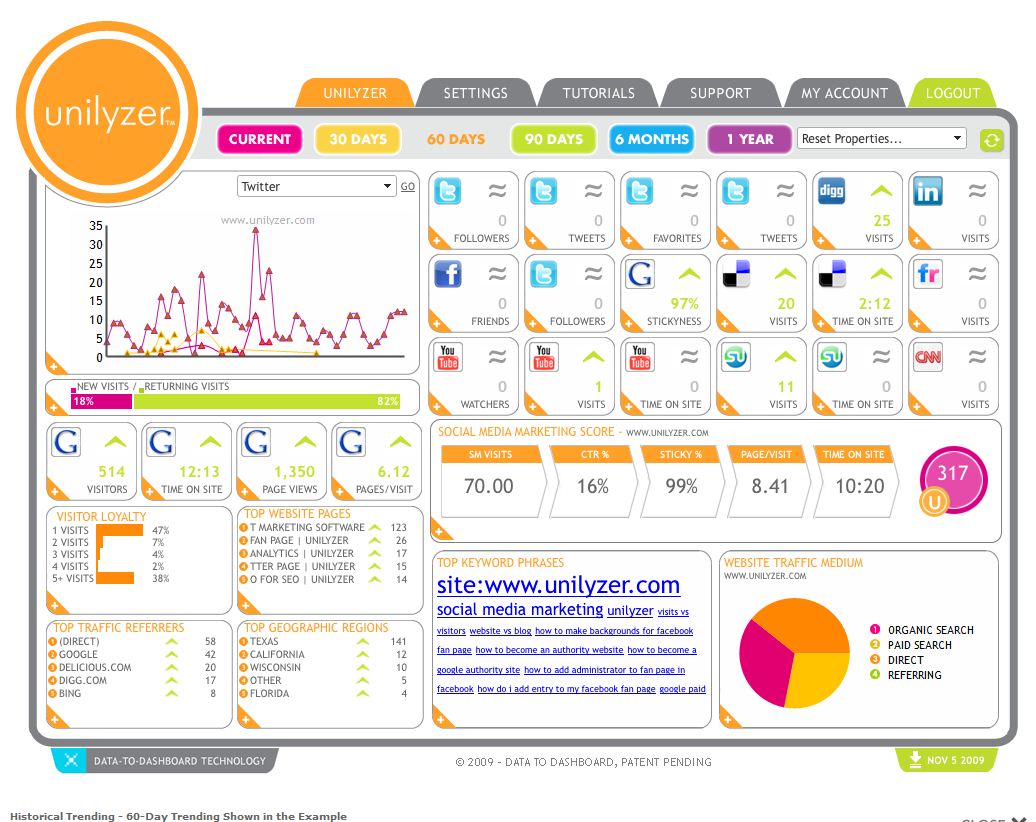
The idea of a social media dashboard is also something that also resonates with me here because dashboards allow us to see trends and determine next actions as necessary. Where dashboards sometimes stop is in taking things to the next level – ‘hey, this topic is trending, why don’t I send this to someone in the x unit to see if they have clients who’d be interested’. I foresee this kind of Trending Dashboard as having a role in facilitating that next step in proposing work to clients. On a recent client engagement, the idea of real time information was incredibly important to the client because their business literally stayed afloat because of their response to that information. In a way, it’s incredibly important to us, too – in winning work because of understanding data in real time, and anticipating what’s next and what’s trending. A quick search for a Dashboard shows us something like this dashboard (from above)- too busy, but an idea of the future where what work we do now is tied to what can be done in the future. Harnessing technology for predictive project work, staying ahead of the competition, building our own tools and collaborating across the firm… that’s what preparing for the future is all about, no?
Regards,