How might we use objects to help heal from trauma?
Exploring how a community based object can help recover from disasters
Product: I created the analysis, strategy and design for a new service for communities, resulting in rethinking the role of designers and utilizing 3D printing technology for healing as part of the ‘Community Resilience’ studio course
A trauma is not a pathological event but a pathologized image, an image that becomes intolerable… If we are ill because of those intolerable images, we get well because of imagination.
– James Hillman, ‘Healing Fictions’ 1983
Situation
Wounds live within us, as scars on our bodies and as invisible emotional traumas. The stories we do not share and the pains we carry unseen bind us together. We have all been hurt and carry wounds. We also live among collectives—people and places—with wounds and stories. As we grapple with massive changes—economic, environmental, migration, and other wounds on the body politic—these wounds will increase. Design should seek ways to understand individual and collective trauma, mourning, memory, and healing. It should also consider how ‘home’ and ‘healing spaces’ can endure amid transient identities, instability, and rapid acceleration. How should we help others heal their wounds—and our own—and evolve and protect these healing spaces and artifacts?
Each first-year student in the MFA in Transdisciplinary Design program has a studio class that synthesizes our coursework and allows us to translate thinking into making. The studio led by Mathan Ratinam focused on community-led resilience—how individuals play a role in disaster preparedness and emergency management, and how design can help communities prepare and become resilient. Our team explored trauma after disaster, personal resilience, and recovery and thriving after trauma. How might we address trauma through digital fabrication? And how might we explore the future of designers?
The Memory Spot project examines how meaning is made from trauma and wounded places, and how objects can address recovery from disasters. We explored the lack of personalized objects of recovery through a new role: a ‘designer as doula’ and storyteller who listens to and illustrates stories of trauma, then 3D-prints them as a wearable button. There is also a ceremonial physical space where the button is created, and a service ecosystem that connects with the community to address collective spaces and trauma. The project is a case study in creating design spaces through a transdisciplinary, open-minded, open-hearted approach to objects of recovery, spaces for healing, and the value of portability, customization, and ceremony in design work. Ultimately, we examine our responsibility as professionals—including designers—to move toward co-creation and midwifery, to bear witness to stories of trauma, to encourage healing and empowerment, and perhaps to foster new dialogues on trauma itself.
Research
This phase involved a lot of work and research played a part throughout the project.
Strategy: Creating hypotheses and areas to explore
Research: We conducted secondary research on objects and trauma and interviewed domain experts. I also conducted external research (a competitive analysis) of similar efforts in the market place that influenced our project.
Design: I sketched ideas of what could be on the buttons on paper and transferred into Illustrator
Prototyping: We created paper prototypes of the idea which we ran by small group of users and refined those prototypes
Production: We conducted laser printing of buttons; we debated on making the buttons 3D printed via a MakerBot, but stuck with laser printing to create more of a crafts-man feel to the button
Secondary research:
Desk research about the complexity of trauma, and precedent research mostly on anthropology. For secondary research, much of my desk research involved understanding trauma, the findings which are included below. The objectives with the method was to this understand complicated domain and how this would be shaped with the use of 3D fabrication – as well as understand how disaster recovery would shape whatever intervention we came up with. The outcome of this method was to better understand our goals – was it healing or self expression, for example – and clarify what our role and responsibility is as designers to deliver interventions where care and healing play a role.
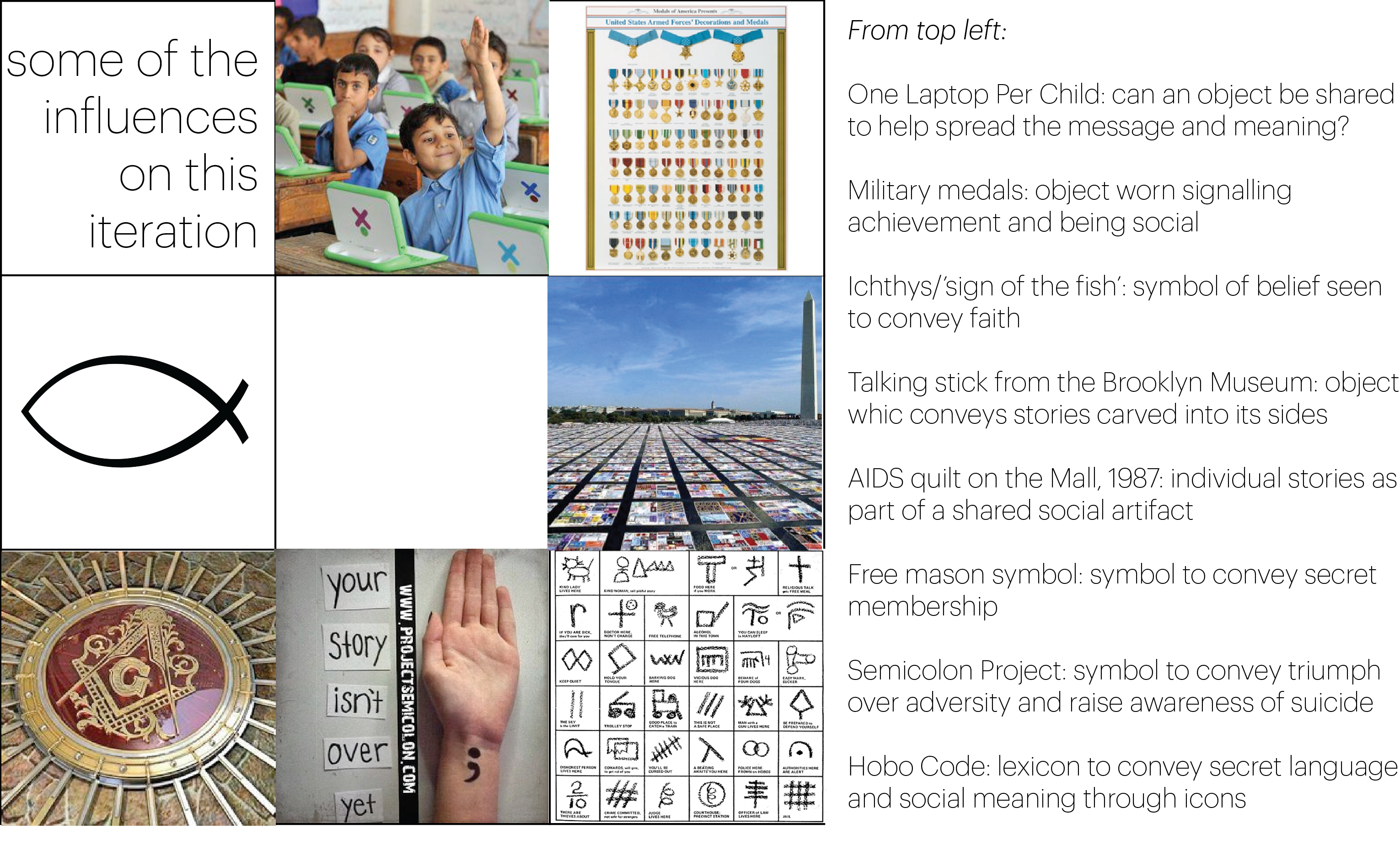
Some of the influences on the project
Contextual research:
Interviews with domain experts at the intersection of art and trauma including an art therapist, psychologist, tattoo artist and people who’ve experienced trauma
For contextual research, this involved speaking to our domain experts and getting a better sense of how objects could be involved in healing, something I would later explore more in my thesis. The outcome was a focus on both objects created but also the role of the designer as a resource in the community that would be used before during and after a disaster.
Participatory research:
We used a number of methods to understand the complexity and pain of issues about trauma, using secondary research methods and primary/contextual research. Participatory design was not a huge focus in this project because of the structure of the class, where the focus was on moving from research to prototyping and creating revisions on prototypes quickly within a three week project.
Analysis
I analyzed how people currently address trauma; each of the existing ‘best practices’ in trauma management fall into three main categories:
Therapy activities (including art therapy)
Spiritual activities (services, memorials etc.)
Artistic, non-spiritual activities (personal art creation outside of formal art therapy, tattoos etc.) to commemorate transitions and survival from a trauma
There is a room outside of these solutions for a customized, personalized design object to reframe these existing solutions, and to incorporate digital fabrication as another tool in our toolkit of how we approach trauma and build resiliency. Objects like talisman and worry beads are examples of cultural artifacts that ‘heal’ or play a role in healing in trauma. Currently, we conceptualize the relationship between objects and emergency and trauma as information sharing (MediAlert bracelet) or notification system (iPhone, Cuff bracelet) or protection of existing resources (insurance card, weapons) or to raise awareness (Livestrong and other political awareness bracelets) – but not as a personalized method of healing. Can our design object change that? And are there positive objects that tell stories and celebrate survival rather than memorials? I came to a few key conclusions through research:
The role of object in healing: We worked to understand the role of objects as a tool to heal people with trauma and promote resiliency after a disaster – and create personalized objects thanks to digital fabrication. Our challenge is ‘finding a way to create objects for recovery’. The root cause of our challenge – that we don’t have a way to self-design personalized objects of recovery, and objects are focused on consumption and not experience – is something we explored
The focus on the individual, not group: For us, resilient people build resilient communities. Our group chose to focus on personal resilience and how individuals experience trauma – and how personalized objects can aid in recovery. The focus was on creating a ‘symbolic, explicative, evocative, sensitizing,, emotional […] metaphorical’ object for the individual and not a ‘collective’ resilient community per se. Trauma in this case can be personal trauma (a traumatic event), or a trauma experienced during a disaster.
Digital fabrication: The promise of digital fabrication for us isn’t just about creating cheaper, quicker (local to distribute) solutions in disasters – it’s also that those local solutions are highly customizable – and thus could be made highly personal. Personalization is the focus of our object.
The importance of experience and performance with objects: we note that objects have an ‘infrastructure’ and performance aspect – some objects have meaning when worn to signify to others, such as rights of passage like graduation (the Armed Forces with military badges, cap and gown), change of status (marriage and rings), birth (name bracelet), milestones (Alcoholic Anonymous’ wooden medallion), political objects (flag on lapel, candidate buttons), objects as fashion and signifier (both clothing and and tattoos)
I also wanted us to look at the lens of public vs. private to understand when one needs to be done in private or when one can use the power of the public in a ceremony:
Mode
Artifact
Type of Action
Level of personalization
Theater/ location of performance
SINGULAR (one way, largely consumption)
None – therapy journal, perhaps
Passive – purchase of object only, perhaps use when alone
All – customized and becomes personal
Private/alone/not shared – in a doctor’s office
PARTICIPATORY (two way, creation and consumption)
Candle in memorial AIDS quilt (with individual stories), potentially this project
Active – co-creation of object, use as part of collective or on own
None – generic, same look and feel for everyone
More public/collective/shared – flowers in a town square after a tragedy
Is there something around ceremony and the ‘award’ of an object we should consider in our team’s object?
These ceremonies are the ‘infrastructures’ that accompany an object. When we mention ceremony, this leads us to public safe spaces. Memorials to tragedies or disasters serve a role for us as communities to honor others and as a place to process grief and trauma – witness the Vietnam memorial, 9/11 and other memorials and museums. What we can focus instead is the role of a private safe space in healing. A confession booth, doctor’s office, smudge tent all demonstrate the importance of place in ceremonies as a private place for ‘healer’ and person requiring healing. These sacred places allow someone to ‘bear witness’ to their trauma and be heard.
Something else we wanted capture was an analysis on how the creation and production of objects (thanks to 3D printing, and other changes in product design) is changing. Perhaps not only is the role of designers changing – design itself is changing, and we wanted to capture that in our object, too. I captured this in the Matrix of changing creativity in ‘memorial’ objects.
Proposed Intervention
We designed service called ‘The Memory Spot’. It consists of three things working together:
Designer doula/storyteller
a storyteller who listens to and illustrates a trauma sufferer’s story
The physical space
a sacred space where the consultation and button creation takes place
Supporting materials
to explain our service, inventory of previous buttons, 3D printer
All of these support each other to turn the design object – the ‘Memory Point’ (or button) – into a healing experience. The doula is an artist and therapist. She uses images to first converse with her clients, then cuts or prints illustrated, textured buttons based on the stories she’s heard. While first a mechanism for her patients to grieve and sort through trauma, the buttons she makes become domestic monuments of remembrance and survival. ‘Spot’ is also a play on the idea of a button as a ‘spot’, but also ‘spot’ as a physical place where the doula would work. The solution would work like this:
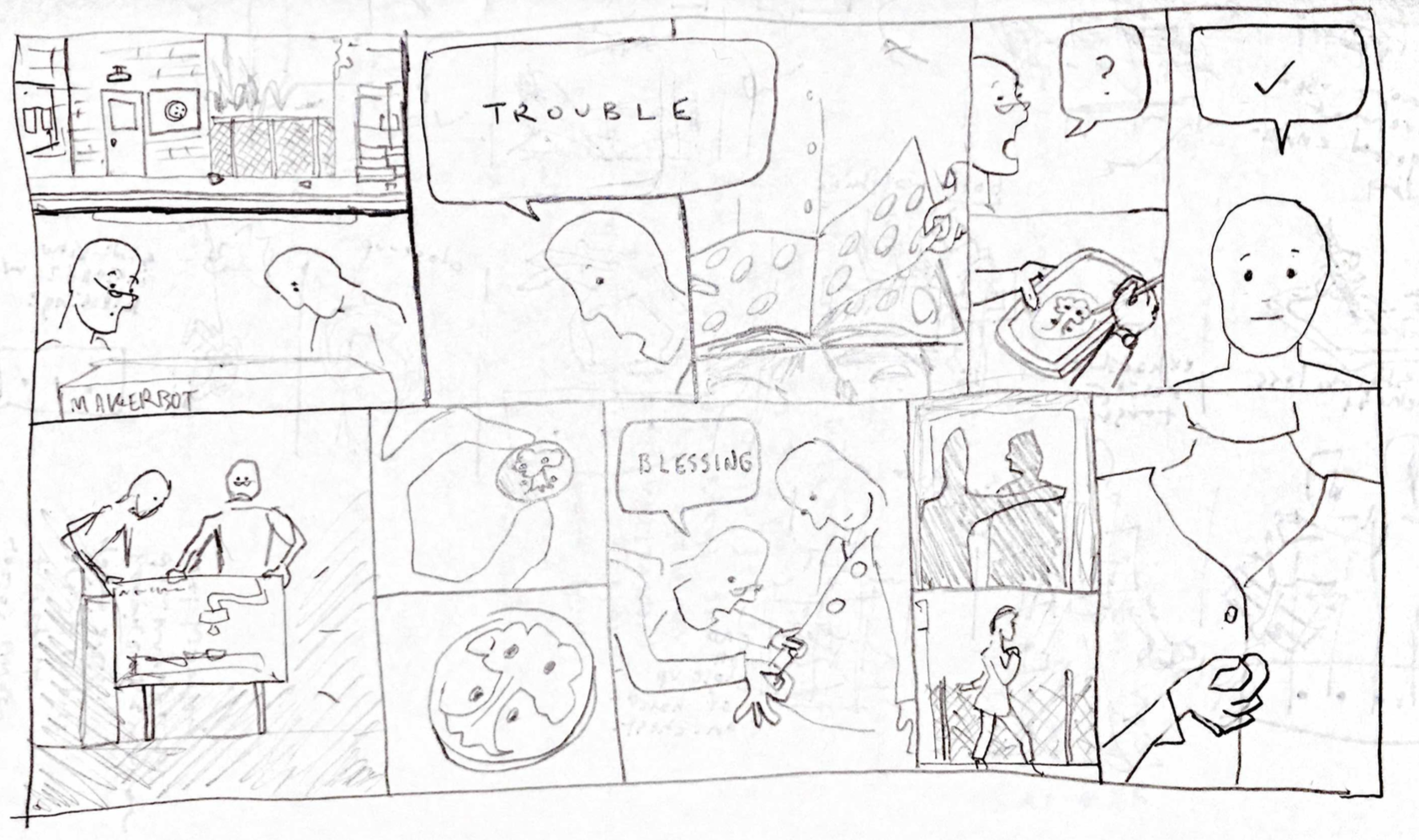
Storyboard from Corey
A person goes to a tent where the designer will be
The designer will be a listener, cleric, doula/midwife providing emotional support as you tell your story where you speak of your trauma
The designer will be a graphic facilitator to help decide what that symbol is – similar to a tattoo artist – and co-creates with you (‘thinking through making’) to ‘bear witness’ to what you’ve been through
The designer creates the image, and prints the image onto a button it in 2D or 3D
Multiple buttons are created, each with a different image since events and memories aren’t confined to a single image or visual representation This also facilitates sharing with others
You receive the buttons right then and there to use them as you wish – perhaps touch them when you feel anxious
Envisioning the act of buttoning
Prototyping the ceremony
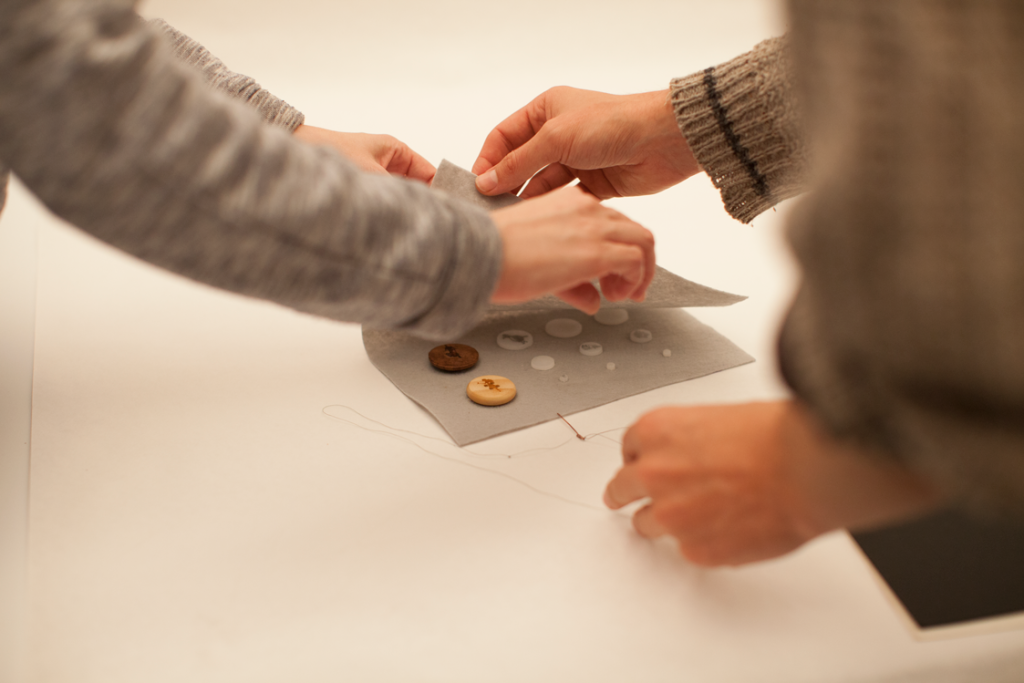
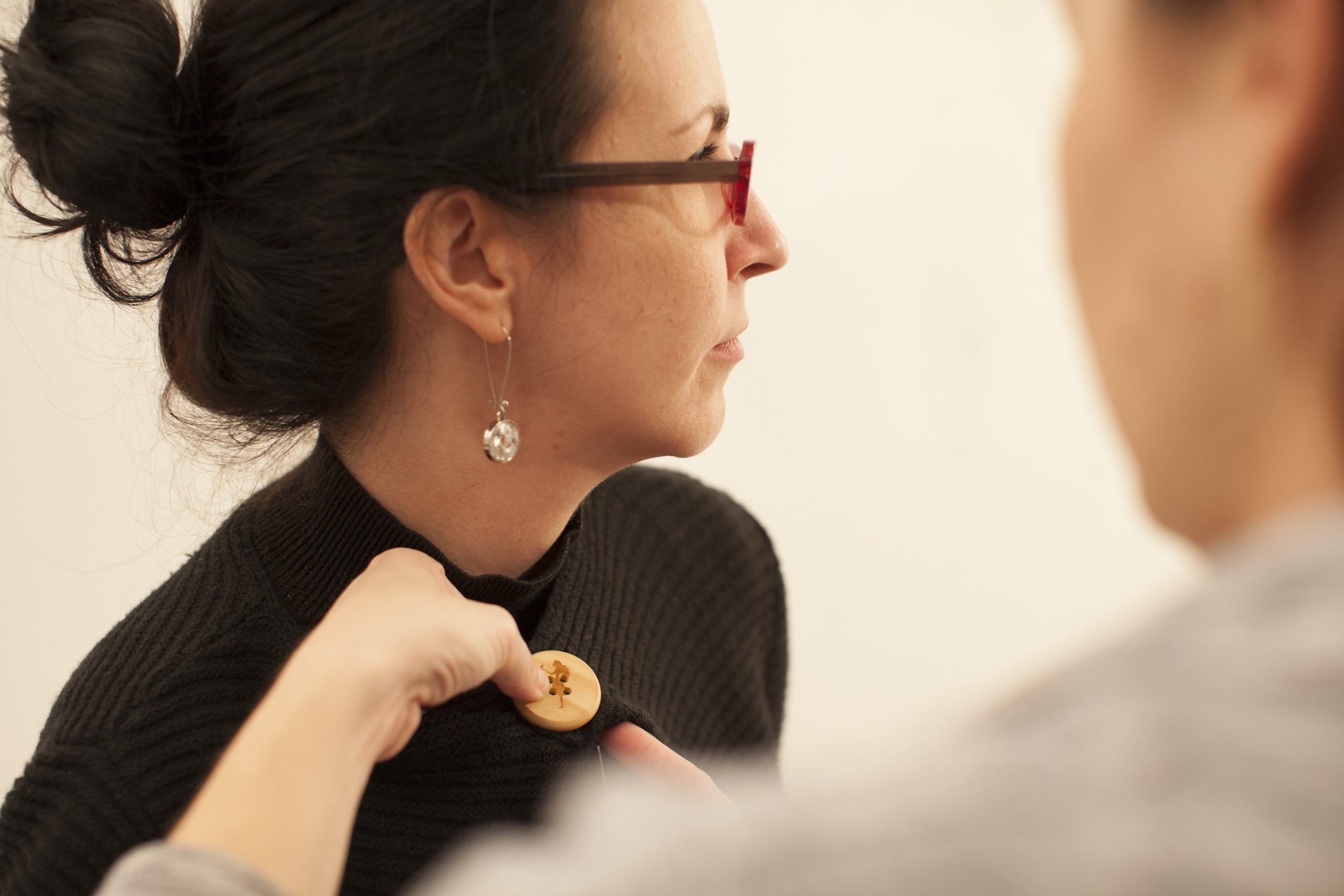
We explored what the ceremony would be like to imagine the act of pining a button on as part of the marking of the event. In this we found having the buttons as something people could permanently attach as part of their clothing a way to boldly mark the importance of the object.
Exploring medium and images
Exploring materiality
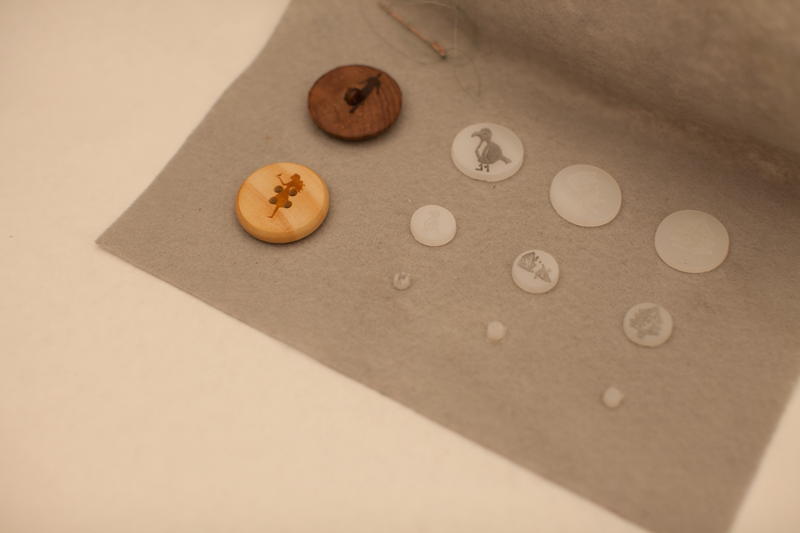
We explored different sizes, mediums (wood vs. plastic) and what the engraving would look like. There would me opportunities to customize depending on people’s needs but realize that that can affect the financial future of the service. We should probably incorporate recycled materials into our work to offset some of the cost.
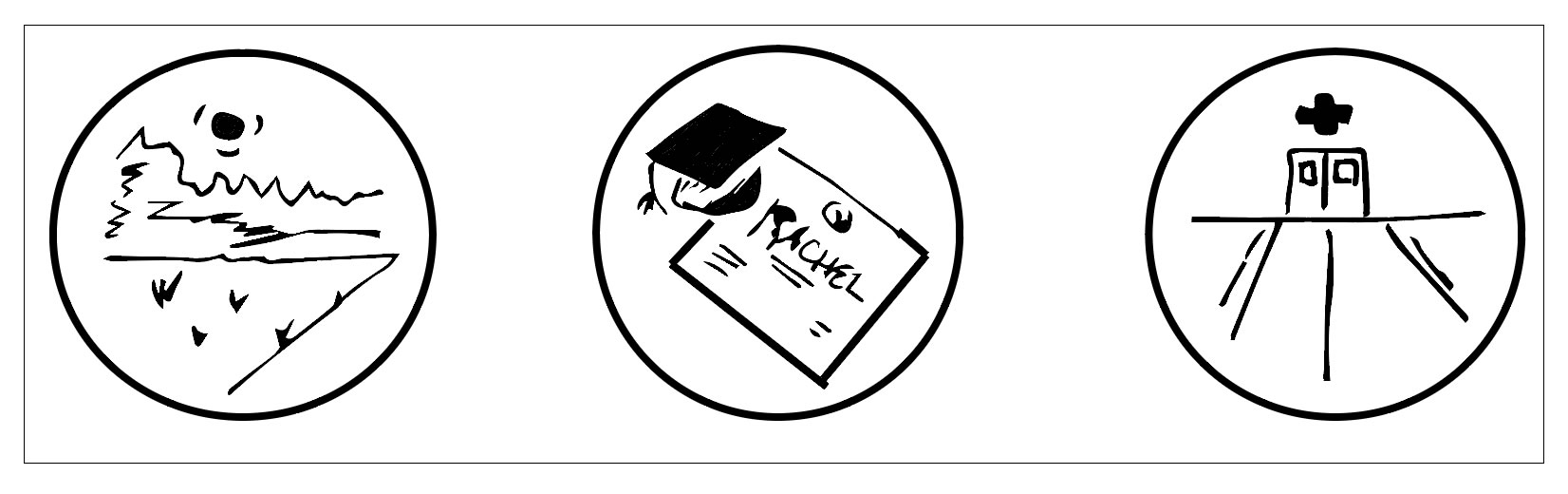
Samples of my ‘resilience’ buttons
Exploring personal healing
I created images from my life that would work as buttons – one involving relocating to another country, receiving my diploma after the death of my grandmother after senior year in university, and the theme of medicine when my mother left the hospital.
When all is said and done, all resistance is a rupture in thought that begins, for those engaged in it, through a rupture with oneself that comes from telling it like it is and drawing the consequences of this ‘telling’. It is declaration of what the situation is, and the foundation of a practical possibility opened up through this declaration.
– Alain Badiou
Simply touching a difficult memory with some slight willingness to heal begins to soften the holding and tension around it – Stephen Levine