CARE card
How might we help individuals stay calm
in the face of danger?
Using graphic design and paper to explore creating a simple reminder of calmness and quick thinking in the face of disaster
- Product: Project ‘CALM card’ for ‘Community and Disaster Preparedness’ course at Parsons School of Design
- Role: Brand strategist, graphic designer, strategist
- Software: Illustrator
- Team: Myself
Situation
Disasters make us panic. How can design help address this?
For our studio class on community resilience (led by Mathan Ratinam) we read Amanda Ripley’s excellent book The Unthinkable and asked ourselves how to design something simple to help bring out the best of ourselves during disasters.
I was also inspired by NYU’s Bobst library which has great signs in their elevator instilling a sense of personal resiliency on campus.
Analysis
My focus was on designing for the following insights:
- How design can tackle or ‘operationalize’ and teach about crises, disasters and resilience while being practical?
- How to create individual resilience from Ripley’s analysis and demonstrate the role design can play in resilience, knowing creating individual resilience a ‘meaty’ design challenge because of the constraints of body and mind that create a ‘tag team’ of negative physiological and psychological responses that occur in emergencies. Also there’s an issue in how to overcome the difficulty in groupthink herd behavior in emergency situations which can override the survival of the individual
- Disaster preparation focuses on the before – the ‘go bag’/72 hours of supplies and afterwards – but not always what to do during the act of disaster
The trained (armed services, medical staff) have a ‘resiliency’ mindset – and some others do with training (first aid, community volunteers etc.)
“The single strongest weapon is a mental plan of what you’ll do in certain crisis” (Ripley, p.79)
What can Ripley’s analysis of general survivors tell us about what it takes to survive? A few basics: preparation, a plan – and, I’m suggesting, an object. I also became obsessed by the concept of a talisman. Why a disaster talisman?
A talisman is an object with magical or sacramental properties such as good luck. It must be ‘charged’ with magical powers by a creator. It is this act of consecration or ‘charging’ that gives the talisman its alleged magical powers. A talisman – or any designed object – can reassure us (like ‘worry beads’) and remind us of a connection, bond or positive emotion. Objects hold emotional meaning, and objects which symbolize bonds are especially important. A Rosary in Catholicism reaffirms one’s religious relationship, a ring symbolizes the commitment of marriage. Having a physical object that can be touched in time of crisis can provide reassurance. How can we design a ‘disaster talisman’ that can be touched that reassures us and reminds us of that we can survive the disaster?
“If you give people an option, something to answer onto when they don’t know what to do, that small help is huge” (Ripley, p. 72)
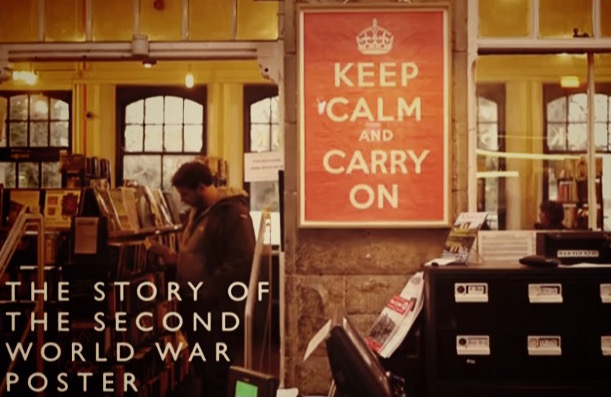
The goal: A disaster talisman to help us stay calm – or rather, stay C.A.L.M. I’ve been inspired by the ‘Keep Calm and Carry On’ posters – both the story by Arseny Vesnin and the artifact itself:
How might we learn the lesson from that design object and apply it to this new object while also keeping it a talisman to hold?
Solution and Design Intervention
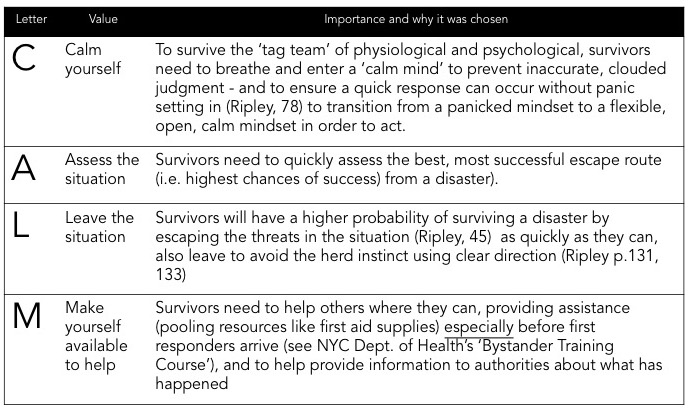
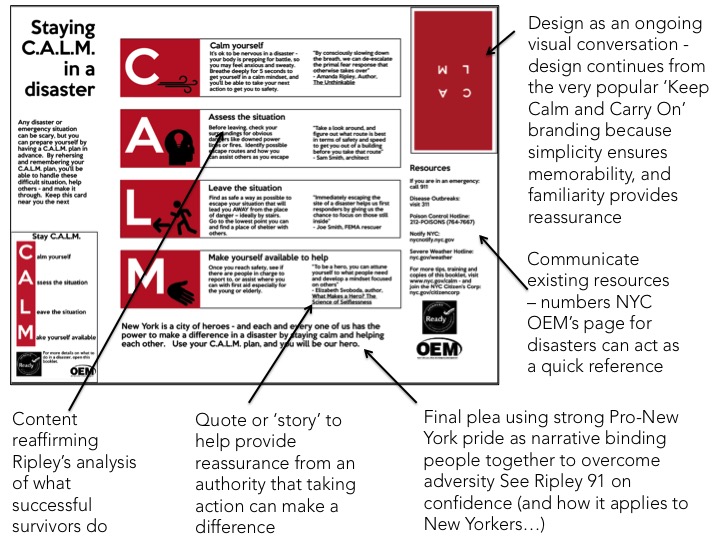
The C.A.L.M. card is a folded wallet size card. The first part of this solution is the actual content or plan of what to do in an emergency. Using Ripley’s analysis, I decided on what content was important, and picked these four letters to represent what to do in an emergency – CALM.
The structure of these words very deliberately follows Ripley’s ‘survival arc’ – ‘denial, deliberation decision’ common to what survivors did which helped them survive. Plans in emergencies need to be short (see ‘Stop Drop and Roll’) and clear actions (‘assess, leave’). C.A.L.M. is a positive brand association. In The Unthinkable, Cirillo the officer trained himself with only positive imagery to ‘clear his mind of any self doubting conscious thoughts’ (Ripley, 70). Just like ‘Keep Calm and Carry On’, positive visualization can provide someone reassurance that they can act in the face of adversity and can survive.
The problem of form and format
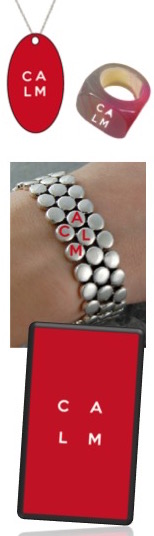
The content – C.A.L.M. – had been solidified, but what about the form for the talisman? The difficulty was in finding a small enough form of an object that can be touched – such as jewelry – but also hold information to be used during emergencies. I explored what the branding would look like and what materiality to use.
A compromise is the concept of a ‘wallet card with paper’ which could provide information in a small form factor. The question remained how much information is useful especially in an emergency?
This is the card folded up:
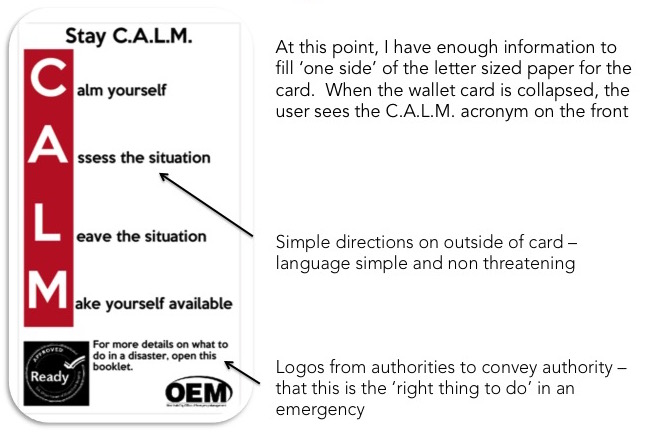
When unfolded, the card contains the following information: