
Lotus Flower
How might we share research in more engaging ways?
A simple exploration of how to deliver assignments in a different way.
- Product: Assignment for the ‘Design-Led Research’ course at Parsons School of Design
- Role: Analyst, graphic designer, user experience designer
- Software: Illustrator, Photoshop, Much Time With a Glue Gun
Situation
Several assignments were created for my Design Led Research class that built on one another’s themes. We were also encouraged to be creative in how we packaged our work, as one of the challenges in delivering research is that people have difficulties engaging in a static printed report. Much of this went back to my experiences with origami and paper folding – are there ways to share research findings via hand-held products that encourage engagement, just like paper objects do?
Analysis
Reflection is a key part of the Transdisciplinary Design program – how we can create designers who are conscious of their design ethics and how we can embed awareness of our own biases into our work. I completed weekly assignments reflecting on my abilities as a designer to understand my influences on my design practice, including:
- Identifying influences: I identified some of the most important influences on my design practice – these were ‘community’, ’emotion’, ‘hackathons and events’, ‘transcendence’ and ‘visualization’. I created a collage of each of these with an image representing the influence and a description of why that influence was important.
- Analysis: I created a competitive analysis of five examples from each of the influences and personal insights about the influence
- Research: I also used a variety of methods in the work, including ethnographic research (AEIOU analysis, surveys, etc.) to better understand the value of the influence and to highlight the importance of data-driven research in what we can do as designers
- Synthesis: I came away with some larger-picture insights from the research and my design work, and I need to tie all of this work together.
Solution
I kept thinking of the phrase from a high school English teacher, Mr. Reed – ‘Writing and understanding yourself is like peeling back the layers of an onion’. How could I use that metaphor to present a very personal set of findings? I found that the lotus blossom flower would be a perfect design object to use, so I built one. Rather than create a report or design a Web site, I sought to push the envelope in how to share information via a physical object that could be explored – reading the ‘petals’ of a flower. I also wanted to create something interactive without utilizing technology like the Internet of Things to create a’Smart Flower’. There is simplicity in creating paper interactivity, something I have always explored via origami.
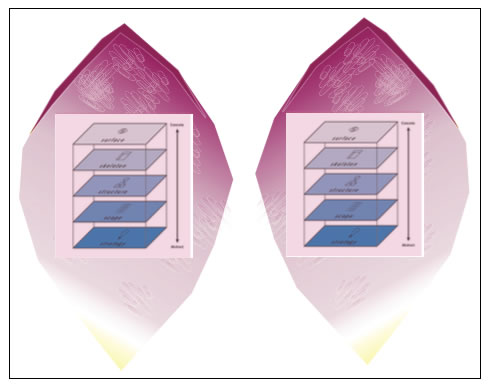
I created small ‘petals’, with images on each ‘flower’ representing influences. This is the front and back of the ‘petal’ for visualization.
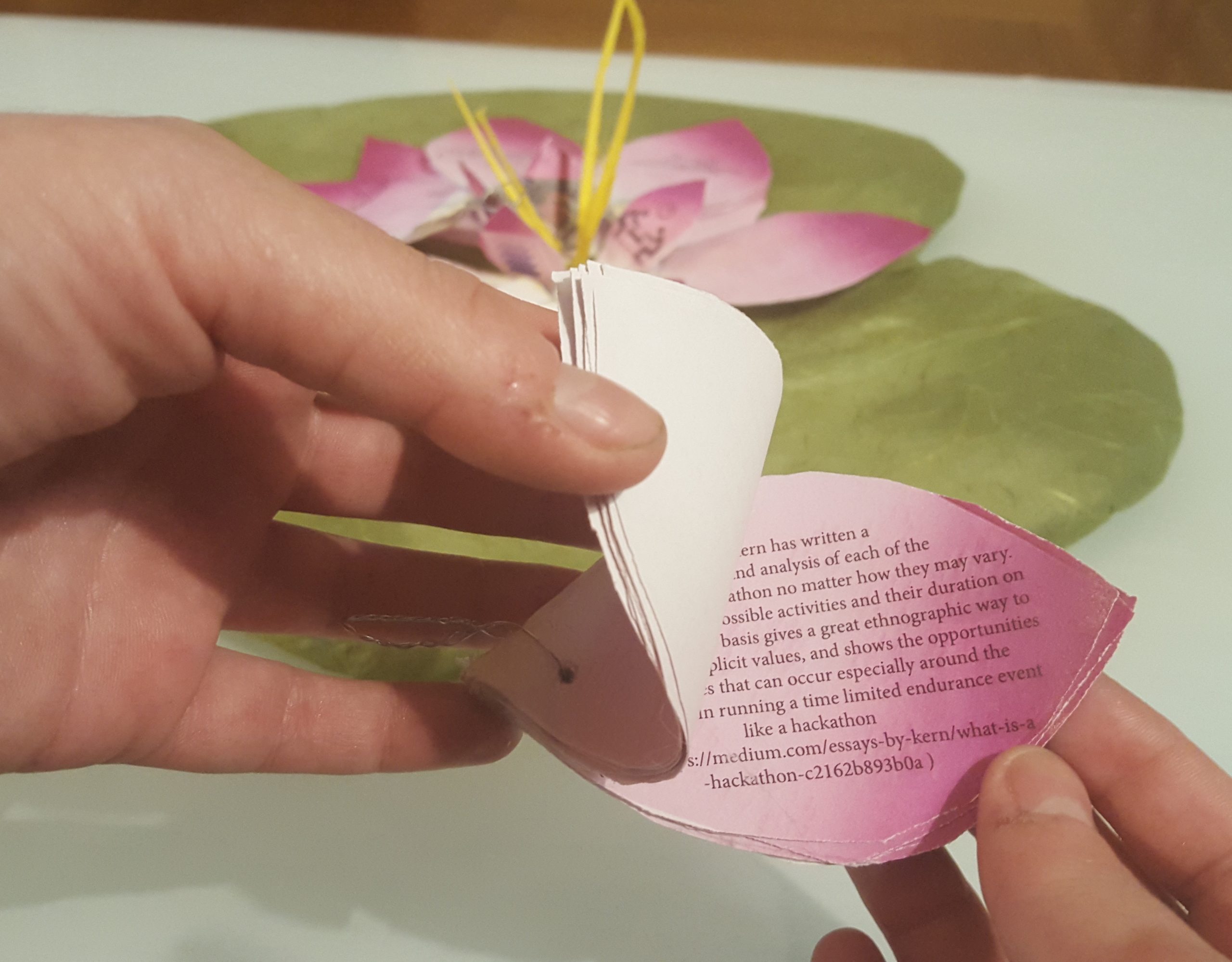
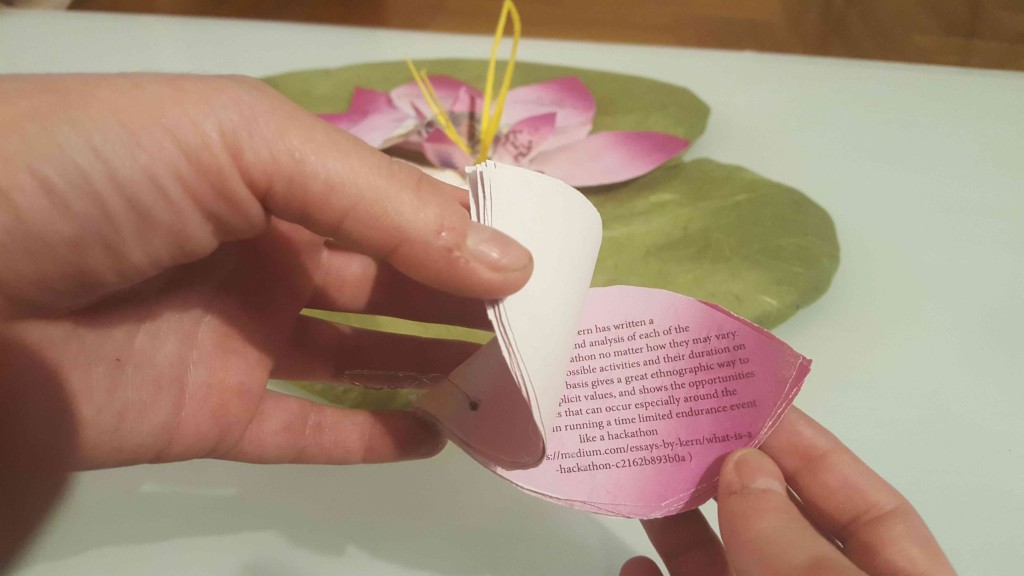
I then created ‘petals’ with the analysis, external research and synthesis work for each influence into a separate ‘petal’ booklet. This is what the ‘booklet of petals’ looked like, which was loosely attached by thin wire to the main lily pad ‘base’
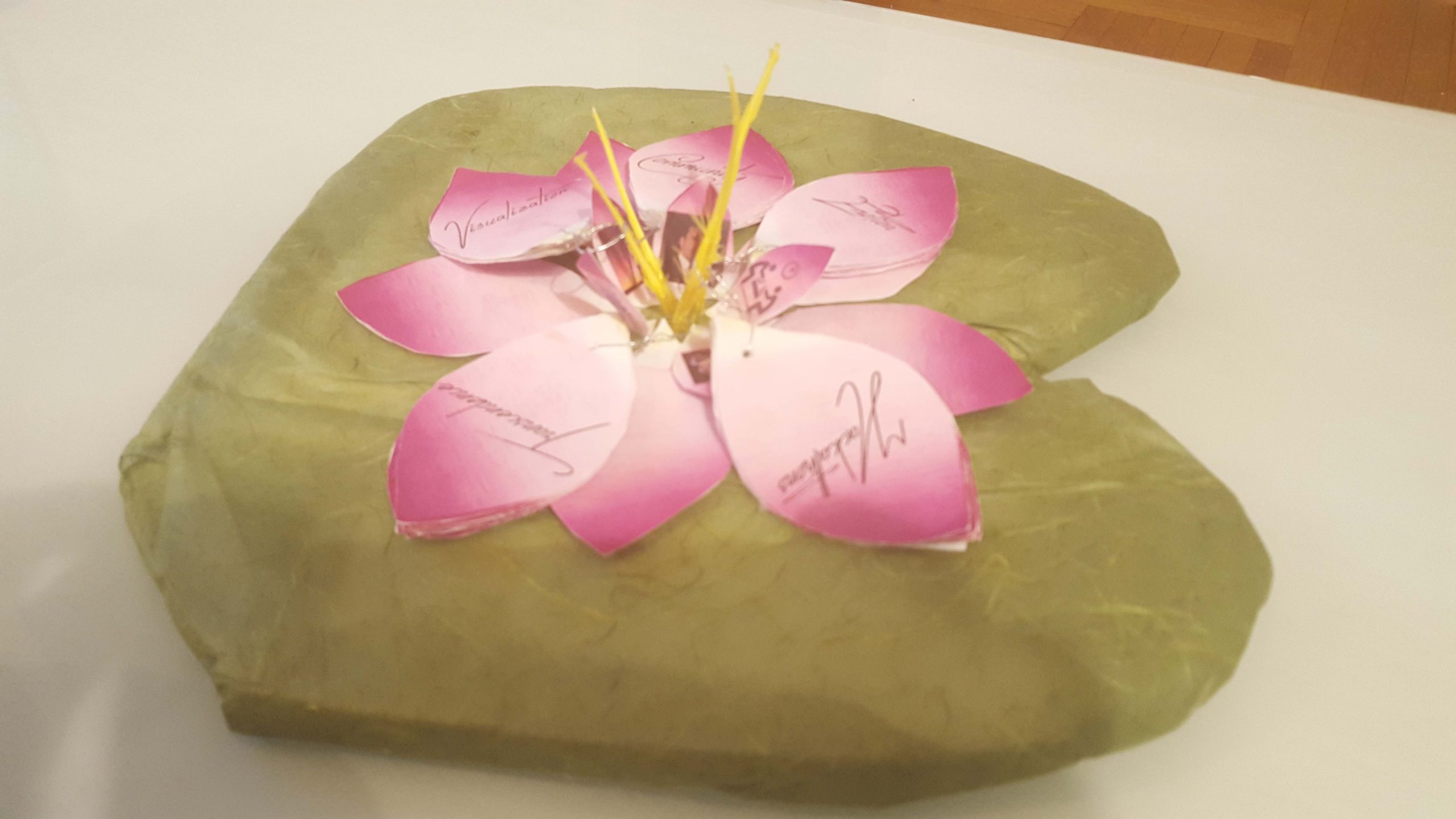
This is what the final object looked like with each of the five bundles attached. Did it push me to deliver something besides a PowerPoint or static Word document, and think more critically about the role of the physical design of objects and paper to create interactivity? Absolutely.
I also provided the written material that couldn’t be included in the flower (such as quantified results from interviews) in a separate document and a summary of what goes into the petals in a print out form. There is an ERAS map to understand the future evolution of visualization. We were asked to engage critically about the things we were doing, so rather than create a simple visualization, I wanted to look at visualization historically to understand how its evolution would also be something to shape my work as a designer in the future.
Result
I was happy with the results because it was a chance to explore the physical as a way to explore engagement rather than only the digital, and hopefully a little delight came to the professors’ day as they explored the flower. The full details are available upon request.

Just like the lotus we too have the ability to rise from the mud, bloom out of the darkness, and radiate into the world – Ann Silver