Maps, legends, threads, and tapestries:
Using art to humanize the lived experience of women with autism
About the work
This work explores how expectations of gender and femininity shape the experience of autism in women—and how underdiagnosis and masking affect our mental health and sense of self. It examines the internal reality of living with autism and the external pressures of what society expects women with autism to be.
Autism has often been mischaracterized as a ‘boy’s condition’. The intersection of ableism and sexism often allows boys and men to express autistic traits freely without being corrected, while girls and women are pushed to mask them. Behaviors called ‘weird’ in women are, in fact, symptoms of autism that have been misunderstood. We are socialized from an early age to suppress autistic symptoms, ironically delaying diagnosis and access to support. Masking and hiding these symptoms becomes a survival strategy to blend in and ‘play normal’. Yet constant performance and inauthentic living lead to exhaustion, burnout, and crisis. Without timely diagnosis or support or a chance to be authentic, many autistic women grow up alienated from our own identities, masking/performing a version of ourselves that society deems acceptable rather than living authentically.
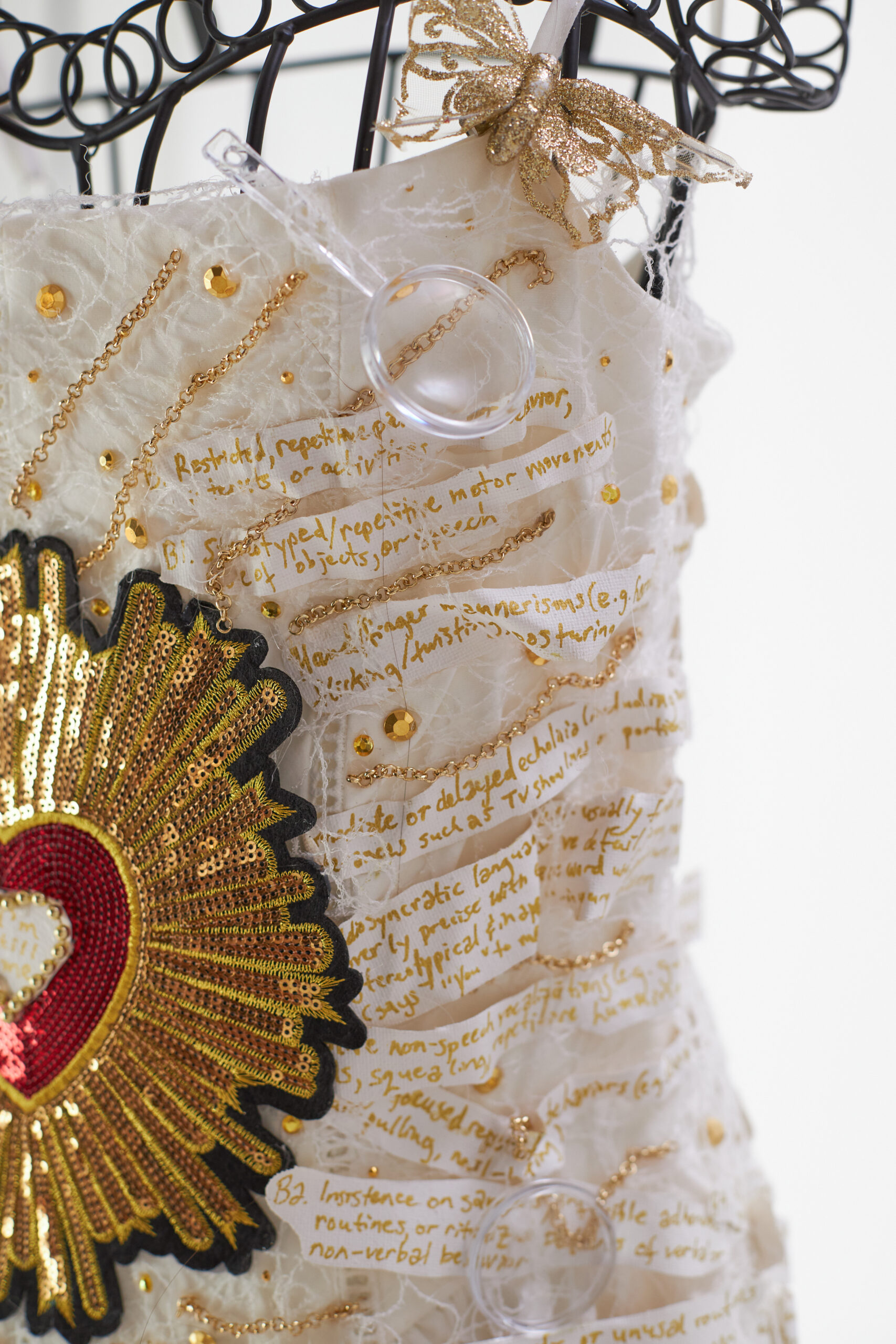
This piece brings those struggles into view. Using women’s fashion to represent gender, the symptoms for autism from the Diagnostic and Statistical Manual of Mental Disorders, Fifth Edition (DSM-5 are written out in gold on the top part of the dress. First-person narratives from the Internet are then accompanied by a painted vignette depicting the symptoms. The clinical symptoms are a ‘medical version’ of us. At the bottom are paintings and personal stories that share how those symptoms show up in our lives. The masks we wear are covered with labels like ‘compliant’, ‘people-pleaser’ and ‘perfectionist’ to symbolize the roles imposed on us. At the center is a heart, reminding us that beyond the medical words and masks lies our true, unmasked selves.
This work envisions a future that embraces the lived experiences of neurodivergent women – one grounded in acceptance, empowerment, and authenticity beyond gendered views of normalcy. Narratives in current politics and media representation do not reflect the beauty in autistic female lives. Our bravery and art can dismantle the masks of what we ‘should’ be and reclaim our existence. This piece invites all of us to embrace the richness of autistic women’s lives, to create a world where our voices are heard not in silence or disguise, but in honesty, bravery, and celebration of who we are. Where is the beauty? In defining our own experiences, in finding glimmers like the sparkles on this dress, and being ourselves after all this time.
Many thanks to the helpers of this project, including Dr. Megan Anna Neff, Laurie Snyder, Jackie Schuld, Tiyé Bazzey, Allie Lisner and the Felicity House team.
Process
This case study will be expanded to discuss the process in coming weeks, incluing the use of AI and future directions
Reference stories
I created a Notebook LLM that holds multiple stories from autistic women to help me identify what to visualize, and hope to expand the use of AI on the project to incorporate Agentic AI, and update this case study with the results.
The future of the project
More photos of the dress will be added here as the project evolves, including:
- STORIES: More stories and codesigning with people in workshops to describe their lived experiences
- AR: Exploring Augmented Reality to bring the stories to life
- DESIGN: What if the dresses could become less about a painting on top of a dress, and more creating a diorama within the dress?

